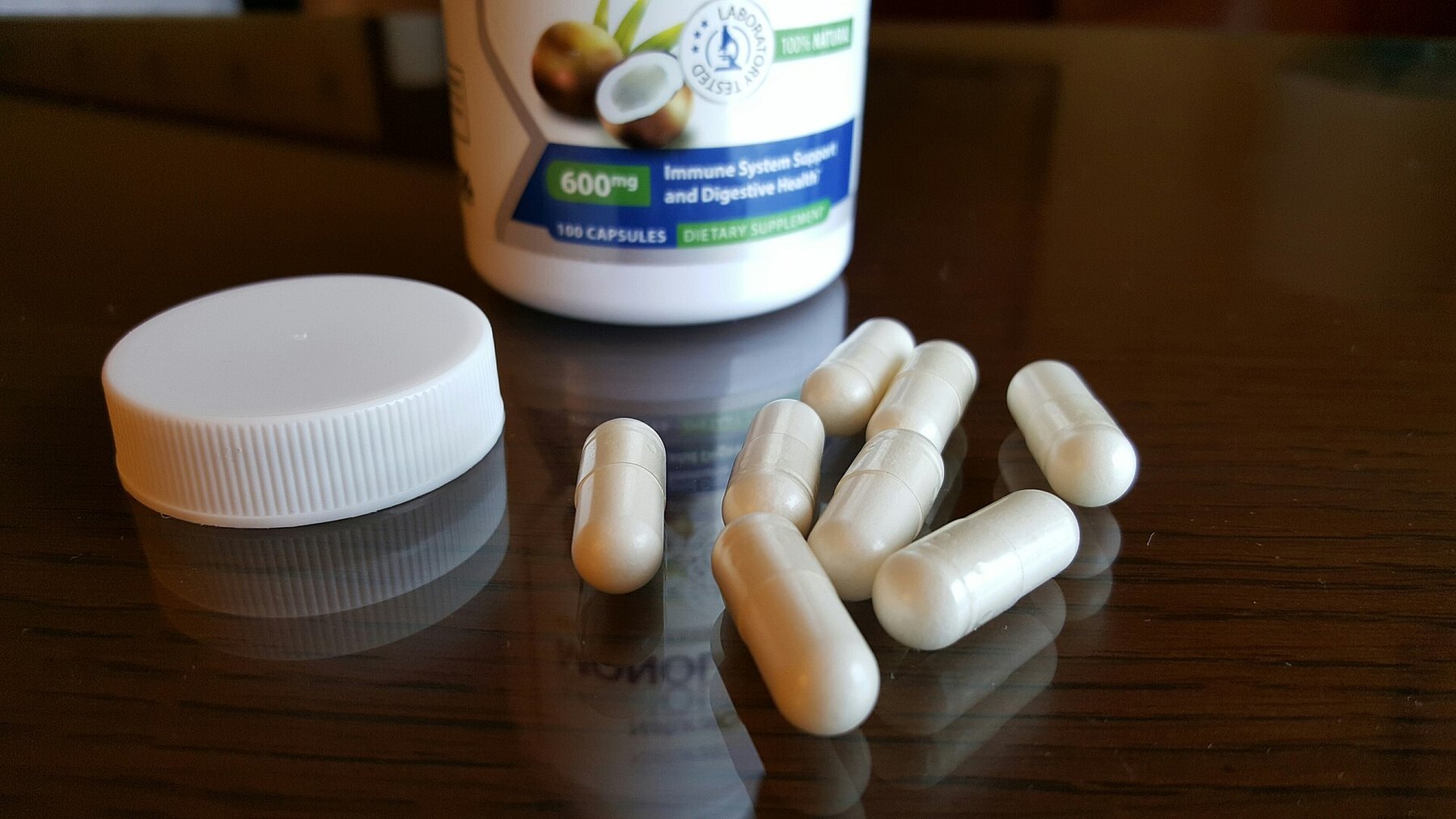
The shelf shows two tubs with almost matching panels, and only one shows a seal. That little seal carries the category promise, that some party outside the sale reviewed that lot and its paper trail.
“someone without a stake in the sale looked at the lot” suggests independence, and independence is the point being sold here. Morning air moves through a back room where jars taken for inventory stand in a row, while the supervisor checks each Supplement Facts box, each other-ingredients line, each lot code stamped by the bottom edge.
A mark draws the eye because federal law creates space for outside review. Under the Dietary Supplement Health and Education Act of 1994, makers and sellers remain legally barred from offering adulterated or misbranded supplements or ingredients. Firms must review the safety and labeling of their products before sale so they satisfy the Federal Food, Drug, and Cosmetic Act and FDA rules. The Food and Drug Administration may act against any adulterated or misbranded dietary supplement product after it enters the market. Dietary supplements are not approved by the Food and Drug Administration before they enter the market.
The order of duties is what matters. A company vouches before sale, the agency intervenes after sale if trouble surfaces, and a buyer in the aisle cannot easily inspect what happened between those points. Third party certification means a separate group with no link to the maker has reviewed a dietary supplement and confirmed its quality and production method. Read third party certification as proof that contents and label align, not as proof of safety or efficacy. A seal therefore calls for limited reading. It speaks to whether contents align with the label under a named method, not whether a blend is appropriate for each home.
What NSF content testing actually measures
The single published standard for third party certification is NSF/ANSI 173-2021. NSF tests products against NSF/ANSI 173, the only American National Standard that sets requirements for ingredients in dietary and nutritional supplements. The program rests on three reviews, label claim review, toxicology review of added ingredients, and contaminant review. NSF Contents Certified relies on testing and review to check that contents match the label, contaminants are absent and good manufacturing practices were followed.
In operation the review shifts from documents to instruments. NSF runs product testing in its own accredited labs to confirm that bottle contents match what the label prints. Each year NSF audits plants and retests each dietary supplement at intervals to confirm ongoing compliance. Only lab testing can reveal true ingredients or doses, and each certifier uses its own method and panel of tested substances. Keep that principle posted near the cabinet. A brand certificate of analysis covers a single lot measured by a single laboratory with a single method. A seal covers a program of review, testing, audit and retest, still limited by its standard.
The benefit is specificity. Contaminant review means named contaminants judged against named limits, label review means stated strength and amounts judged against a method, manufacturing review means practice judged against a rule. Retail placement and buyer confidence do not establish safety or efficacy, since certification shows contents and label align and not that safety or efficacy was judged. A Contents mark reduces one risk, divergence between bottle and label plus listed contaminants, while risks outside that definition stay unaddressed.
Only lab testing can confirm the real ingredients and doses, and each certifier follows its own protocol and panel of substances screened.
Where USP verification adds dissolution and plant review
USP Verified means the product holds the label ingredients in the stated potency and amounts. A USP Verified product has been checked to confirm that listed contaminants such as heavy metals and pesticides stay below harmful levels. In the same program USP Verified means the product was made under FDA Good Manufacturing Practices, with clean and tightly controlled methods. A USP Verified product is watched as it breaks apart and dissolves on schedule so dietary ingredients can release and absorb.
The route to the mark passes through the factory as well as the assay. To earn the USP Verified Mark, makers must pass a site audit for USP General Chapter <2750> and FDA current Good Manufacturing Practices in 21 CFR Part 111. USP verification adds lab testing of samples for fit with USP NF standards or suitable pharmacopeial or maker specifications. USP runs retail testing of USP Verified dietary supplements to confirm the product still meets quality standards. USP verifies supplements with vitamins B, C, D and E, minerals like calcium, and other products like melatonin, CoQ10, botanicals and probiotics.
Boundaries deserve attention. USP certification covers only products sent in and approved for verification, not every product from a maker. A company can earn verification for one calcium tablet while other lots and formulas sell without that same scrutiny. USP Verified reviews label accuracy and named contaminants but omits testing for banned substances tied to anti doping or drug testing programs. For a household weighing heavy metals and label strength, that scope aligns. For an athlete subject to testing, a different screen is required.
Why drug screening for sport answers another question
Supplements meant for athletes that seek NSF Certified for Sport are screened for 280 substances banned by most major athletic groups. NSF Certified for Sport screens for concealed ingredients like stimulants, narcotics, steroids, diuretics, beta 2 agonists and masking agents. That mark is recognized by the NFL, NFL Players Association, MLB, MLB Players Association, PGA, LPGA and Canadian Centre for Ethics in Sports. BSCG Certified Drug Free analyzes every finished product lot for over 450 banned substances, including more than 400 compounds on the World Anti Doping Agency Prohibited List.
The separation rests on the unit examined and the list applied. A contents program asks if the label claim holds and if named contaminants remain below limits. A sport program asks if a finished lot holds compounds that could cause a failed test, including hidden ingredients missing from the panel. GMP certification audits methods and controls but does not prove finished lots lack drug contamination or verify lot by lot label claims. Lot by lot drug screening thus answers a tighter and stricter question, while leaving wider nutrition questions to other standards.
No seal on the tub means it was tested for every substance out there. No one states how often any certified product lot is retested apart from scheduled audits and retail checks. There is no clear proof that a seal alters the odds of harm for a given person or condition. So nothing states which seal, if any, a buyer should trust for products and ingredients left unlisted. The fair reading is comparative, not absolute. Fit the seal to the risk inside the bottle at hand, whether that risk is fill weight and label potency, heavy metals and pesticides, or sport eligibility under a named prohibited list.
The stance stays simple. Ask which lot was tested by whom against which standard, read whether the mark covers contents, contaminants, manufacturing or banned substances, and keep the receipt beside the lot number. Where papers name the grower, the extract ratio, the lab and the limits, note it favorably. Where the chain remains opaque, state it plainly and wait for papers before paying extra.

Victoria Hawkins
Victoria looks after the brands Half Life works with and makes sure every sponsored page is labelled and dose-checked like the rest. She spent six years in regulatory affairs at a supplement maker, so she knows exactly what a label is allowed to say.
More from Victoria Hawkins →